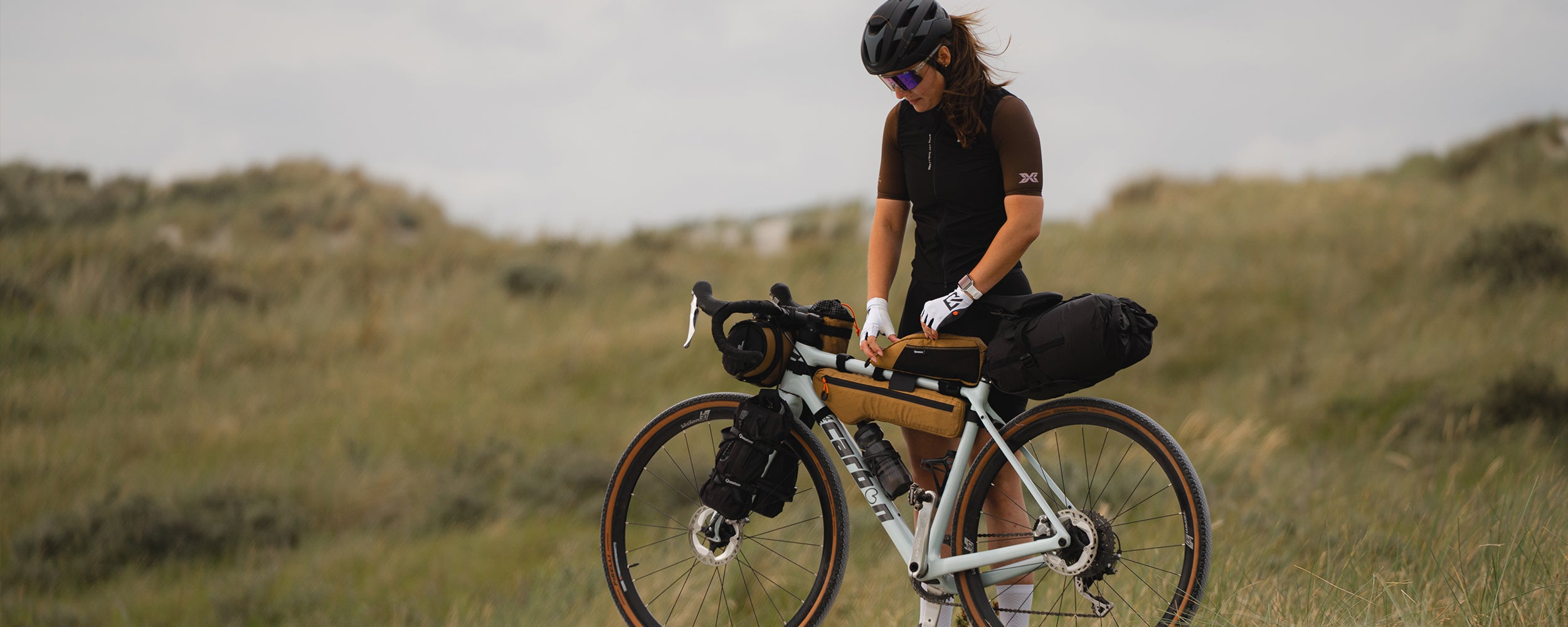
Bikepacking Straps vs Bungee Cords: Which Is Safer for Long-Distance Riding?
Choosing between bikepacking straps and bungee cords directly affects how stable your gear stays on long-distance rides. This guide breaks down how each system performs under real-world vibration, weather, and load conditions, and helps you understand which option is safer for multi-day cycling adventures.

Long-distance bikepacking is not just about endurance or route planning. Once you leave paved roads and enter gravel, forest tracks, mountain passes, or remote highways, the smallest equipment decisions begin to matter in a much larger way than most riders expect. One of the most underestimated choices is how you secure your gear to the bike.
At first glance, bikepacking straps and bungee cords may appear interchangeable. Both can hold a dry bag in place, both can be attached quickly, and both seem to solve the same basic problem. However, once you move into real multi-day riding conditions where vibration, terrain impact, weather changes, and fatigue all interact continuously, the differences between these two systems become much more significant.
This article breaks down how each system behaves under sustained real-world load conditions and which one provides a safer, more stable solution for long-distance riding.
Why Gear Security Matters More in Long-Distance Bikepacking
Unlike casual riding or short weekend trips, bikepacking introduces a continuous mechanical stress environment that never fully resets during the ride. Every mile adds thousands of micro-vibrations to the bike frame and anything attached to it. Even on relatively smooth gravel roads, this constant movement gradually tests every fastening system on the bike.
As terrain becomes more technical—rocky descents, forest singletrack, washboard gravel roads—gear is repeatedly exposed to sudden directional forces. These forces are not always strong enough to cause immediate failure, but they gradually create micro-shifts in load positioning.
At the same time, riders often carry asymmetric and multi-density loads such as sleeping systems, cooking equipment, and waterproof storage. This creates uneven tension points that amplify weaknesses in any fastening system.
Weather further complicates performance. Rain reduces friction, mud increases mass and movement, and temperature fluctuations can affect elasticity and stiffness. In combination, these factors make gear retention not just a convenience issue, but a core safety requirement.

How Bikepacking Straps Work as a Stability System
Bikepacking straps are designed around one fundamental principle: maintaining stable tension under continuous vibration without relying on elasticity.
Unlike elastic systems, straps use mechanical tightening combined with frictional resistance to maintain position. Once tension is set, the system does not continuously “react” to movement. Instead, it holds a fixed state, which is critical in long-distance riding environments.
Modern strap systems typically rely on reinforced webbing materials and surface engineering designed to increase grip against dry bags or frame surfaces. In real bikepacking setups, they are commonly used for fork-mounted cargo, frame bags, and rear load systems where stability is more important than quick adjustment.
In practical application, systems similar to Qunature bikepacking straps follow this same engineering logic: controlled tension, non-elastic behavior, and vibration resistance for multi-day riding conditions.
Material Engineering Behind Strap Performance
Strap performance is not defined only by structure, but also by material composition. Qunature uses two distinct strap constructions, each optimized for different riding environments.
One version is built from a composite of 70% polypropylene and 30% latex. This material combination creates a hybrid behavior system where polypropylene provides structural strength and abrasion resistance, while latex introduces controlled elasticity.
In real-world riding, this means the strap can absorb small tension fluctuations caused by vibration or shifting loads. It is particularly useful when securing softer or slightly compressible gear. However, because elasticity is part of the system, tension behavior is more dynamic and may vary slightly over very long distances or highly technical terrain.
The second version uses a TPU polyether-based construction, which represents a stability-focused engineering approach. TPU does not rely on stretch behavior. Instead, it provides structural consistency and surface stability.
The polyether formulation improves flexibility in low-temperature conditions while maintaining consistent tensile resistance. It also reduces water absorption and improves friction stability in wet or muddy environments, helping maintain more predictable load positioning during long-distance riding.
From a system perspective, polypropylene-latex represents a controlled-elastic design, while TPU polyether prioritizes dimensional stability and environmental resistance.
Both are valid approaches, but they behave differently depending on terrain, weather, and load type.

What Makes Bungee Cords Fundamentally Different
Bungee cords operate on an entirely different mechanical principle. Instead of resisting movement, they absorb it through elasticity. The core material is designed to stretch under load and return to its original shape, generating tension through stored energy.
This makes them extremely convenient for short-term use. They are fast to attach, adaptable to irregular shapes, and require minimal adjustment.
However, in long-distance bikepacking environments, elasticity becomes a variable rather than an advantage. Each stretch-and-release cycle introduces small inconsistencies in tension. Over time, these inconsistencies accumulate, especially under continuous vibration.
On rough terrain, this leads to subtle oscillation of gear rather than fixed positioning. While each movement may be small, long-duration riding amplifies their cumulative effect.
Elastic materials also experience fatigue over time, especially under UV exposure, moisture, and repeated loading cycles, which gradually reduces holding reliability.
Real-World Behavior During Long-Distance Riding
The difference between straps and bungee cords becomes more visible over time rather than at the moment of setup.
Straps maintain relatively stable tension profiles throughout a ride. Once properly installed, they resist loosening even after extended vibration exposure. This makes them particularly suitable for carrying essential gear such as sleeping systems or waterproof storage that must remain stable regardless of terrain variation.
Bungee cords, in contrast, gradually shift from stable tension to fluctuating tension behavior. This shift is subtle at first but becomes increasingly noticeable over longer distances. Gear may begin to move slightly under load, especially during climbs, descents, or prolonged gravel sections.
In practical riding terms, this affects not only gear stability but also bike handling consistency. Even small shifts in load distribution can influence balance and control over technical terrain.

Which System Is Safer for Long-Distance Bikepacking?
From a safety and reliability perspective, bikepacking straps are significantly more suitable for long-distance riding.
The key factor is not maximum strength, but consistency under sustained mechanical stress. Long-distance riding is defined by repetition: repeated vibration, repeated load redistribution, and repeated environmental exposure. Systems that behave predictably over time are inherently safer than systems that change behavior during use.
Bungee cords still have value in short-distance, low-risk, or temporary applications. However, when carrying essential gear across remote or technical terrain, they introduce too much variability to be considered a primary load-bearing solution.
Which Bikepacking Strap Should You Choose?
Not all bikepacking trips place the same demands on your gear system. The right strap choice depends less on preference and more on how, where, and how long you ride.
If your riding involves long-distance or multi-day routes where gear stability is critical, a more stability-focused system is generally the better choice. TPU polyether-based straps tend to perform more consistently in these conditions because they are less affected by moisture, temperature change, and prolonged vibration. They are commonly used for securing dry bags, sleeping systems, and heavier cargo where movement must be minimized throughout the entire ride.
If your riding style includes shorter trips, mixed terrain, or frequent gear adjustments, a controlled-elastic system can offer more flexibility. The polypropylene and latex composite allows slight elasticity, which can help absorb minor vibration changes and makes it easier to secure softer or less rigid items. This is often preferred when gear is not fixed for the entire duration of the ride.
Weather is another deciding factor. In wet, muddy, or highly variable environments, TPU-based systems generally provide more stable behavior because they maintain friction and do not absorb water. In contrast, elastic composite systems may perform better in dry, moderate conditions where flexibility is more useful than absolute stability.
In real-world bikepacking setups, many riders naturally combine both approaches, using stability-focused straps for primary load points and more flexible systems for secondary or adjustable gear. The key is not choosing one “best” strap, but matching the material behavior to the role it plays in your system.

Final Thoughts
Bikepacking requires a level of equipment reliability that goes far beyond casual outdoor use. While both straps and bungee cords can physically secure gear, their behavior under real long-distance conditions is fundamentally different.
Bungee cords prioritize speed and elasticity, but introduce variability under sustained vibration. Bikepacking straps prioritize structural stability and predictable load behavior, which becomes increasingly important as terrain complexity and ride duration increase.
For riders planning multi-day routes or carrying essential equipment across unpredictable environments, strap-based systems remain the more dependable and structurally appropriate solution.